

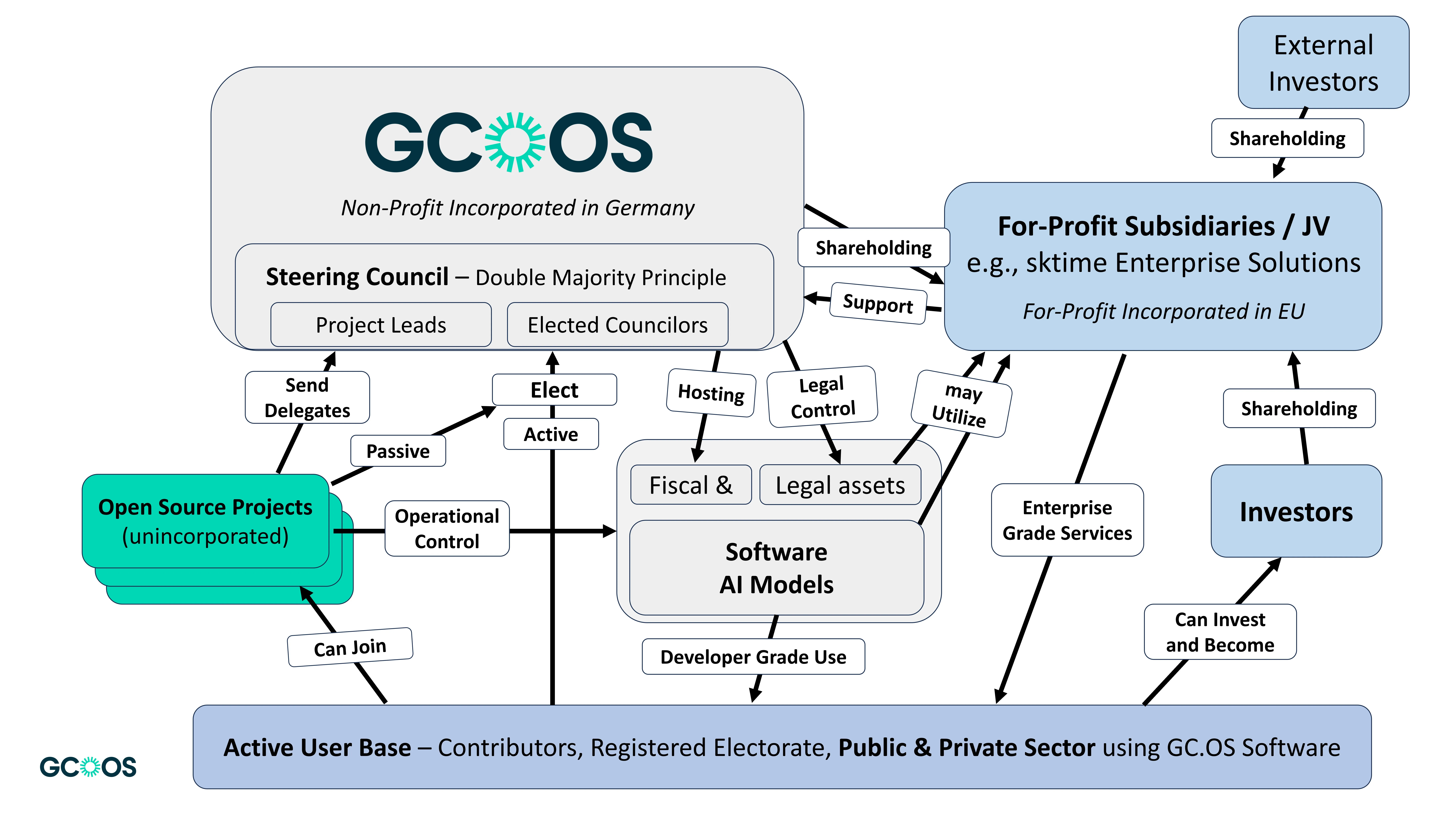
Introducing our new governance structure
A sustainable design addressing a long-standing structural problem in open source and AI ecosystems:
How do you scale global technology infrastructure without losing public ownership of its core?
Traditional models fail in different ways:
- Pure decentralized open source struggles with funding and efficient coordination, and sometimes a developer elite walls itself off from the wider contributor base
- Pure corporate models inevitably lead to enclosure, misalignment with public interest, and autocratic governance; they smother innovation and creativity under profit incentives
- Foundation-only models lack commercial scalability and tend to struggle with coordinated uptake into user organisations; they also often collapse into corporate capture patterns
Our new hybrid approach strives to combine the strengths of all three:
- Open source innovation and sovereignty
- Non-profit stewardship and participation
- Commercial sustainability, scaling, and efficiency
While meeting mounting challenges in the age of AI:
- The need for global-scale software infrastructure, AI systems, enterprise services
- Changing geopolitical realities necessitating sovereign governance architecture
- Increasing attempts by hegemonic actors to control the software supply chain
Over the last year, we have developed a governance model that balances our mission with the increasing demand of a growing European and international user base for professional delivery of AI, self-sufficiency, and sovereignty.
Our model combines a non-profit foundation, for-profit subsidiaries, open source projects, and an active user base, into a single coherent system of checks and balances - merging patterns of democratic participation, our mission of AI for the common good, and economic growth.
Let’s look at the governance model in more detail.
The Core: A Non-Profit Stewardship Foundation (GC.OS)
GC.OS, a non-profit incorporated in Germany, acts as the constitutional cornerstone of the ecosystem. Bound by German non-profit laws, the setup prevents capture by a single commercial actor. Participatory, living, and open governance by the community will keep the mission alive, acts as a guard against critical design flaws such as a static board that could allow easy takeover.
The primary responsibilities of GC.OS include:
- Holding and governing key legal assets on behalf of affiliated open source projects, where desired
- Coordinating fiscal assets (funding, grants, infrastructure budgets), and acting as fiscal host for affiliated open source projects without their own legal incorporation vehicle
- Hosting and overseeing foundational infrastructure
- Ensuring alignment with the public benefit mission
- Acting as a representative body, and efficient governance body, for the ecosystem
A steadily growing ecosystem will help solidify the legal setup and streamline participatory operations.
YOUR help is needed, join!
Governance: The Steering Council and Double Majority Principle
Decision-making power is delegated to a Steering Council, which operates under a double majority principle.
The council is composed of two groups:
- Project Leads (technical and operational leadership)
- Elected Councillors (community-represented governance)
This structure ensures that neither technical leadership nor popular opinion can dominate independently. Instead, major decisions require alignment of both.
The Steering Council is responsible for:
- Electing or confirming leadership roles
- Sending delegates into operational structures
- Ensuring alignment between mission and execution
This “dual legitimacy” model is designed to balance expertise with democratic accountability, preventing both populism and developer elitism (and hostile takeover strategies relying on either).
The Open Source Layer: Unincorporated but Foundational
The technological engine of the ecosystem are affiliated Open Source Projects.
These projects:
- Are the primary source of innovation and development
- Remain legally independent (no corporate ownership)
- Delegate representatives to the Steering Council
This ensures that innovation remains bottom-up and not constrained by corporate boundaries.
The model explicitly avoids absorbing open source projects into rigid corporate structures, preserving flexibility and community ownership.
The Economic Engine: For-Profit Subsidiaries and Joint Ventures
On the right side of the diagram are for-profit subsidiaries and joint ventures, such as enterprise service companies.
These entities:
- Provide enterprise-grade AI services, tooling, and infrastructure that loose networks of freelancers cannot provide, e.g., reliable delivery of larger projects.
- Are incorporated in the EU as for-profit organizations, subject to solid legal anchors
- Are co-owned, by the non-profit foundation as a shareholder (typically 30-50% founder shares)
- Generate revenue to sustain the broader ecosystem
- Allow flow of investor capital into the ecosystem - including for strategic investment into the participative, sovereign model of AI innovation.
Importantly, the relationship is not one of domination but of symbiosis:
- The non-profit holds shareholding rights
- Subsidiaries receive privileged support and legal coordination
- The non-profit retains legal control over core assets, ensuring independence of the open source basis for the technology
This creates a clear delineation between mission governance and commercial activity while still enabling investment and professional operations on the direct interface to private and public sector.
Software and AI Models as Shared Infrastructure
At the center of technical operations is the core of the AI value chain - Software Components and AI Models, which function as shared infrastructure.
These assets:
- Are developed through open source collaboration
- Are used by developers directly
- Are embedded into, and basis for, enterprise services
- Are legally anchored via the non-profit structure
They are neither purely commercial nor purely community-owned - they are commons infrastructure with structured commercial interfaces.
The Active User Base: The Living System
At the foundation of the model is the Active User Base, which includes:
- Contributors and Registered electorate participants
- Public and private sector organisations using software components or enterprise services
This group plays multiple roles:
- Contributing to open source projects
- Participating in governance and elections
- Consuming - and potentially co-designing - enterprise and developer services
- Investing into the for-profit branch, possibly in synergy with existing AI tool use
This creates a continuous feedback cycle between users, governance, and development - with checks and balances ensuring a trajectory in the interest of users.
Checks and Balances: A Distributed Flow of Control
Several key relationships define the system’s stability:
- Operational control flows from governance into projects and infrastructure
- Legal control of “critical commons” technology is held at the non-profit layer
- Shareholding links the non-profit and commercial entities while legal structure prevents collapse of either side into the other
- Democratic governance and elections ensure checks on decision makers and guard against hostile takeovers
The system is designed to avoid any single point of capture - e.g., by hostile investors, cloistered foundation leadership, or populist leaders.
Democracy Lives In Participation
Our design is inherently, and intentionally participatory.
As with state governance, the system lives - or dies - with the people in it. We, The People will decide how technological power will be distributed in the future, and how it will be wielded.
Therefore, we ask everyone to participate in our upcoming elections - details to be shared in a soon upcoming announcement.